Imagine you’ve just been told, at a routine appointment, that your weight is affecting your health.
You go home. You do what almost everyone does: you look it up. You find the NHS page on overweight and obesity — the one most people reach first, because it’s the NHS and you trust it.
And now, part-way down that page, there’s a link to us.
What changed
Since 19 May 2026, the NHS Overweight and obesity conditions page has linked directly to Obesity UK.
It’s a small change to one web page. Its effect has been anything but small.
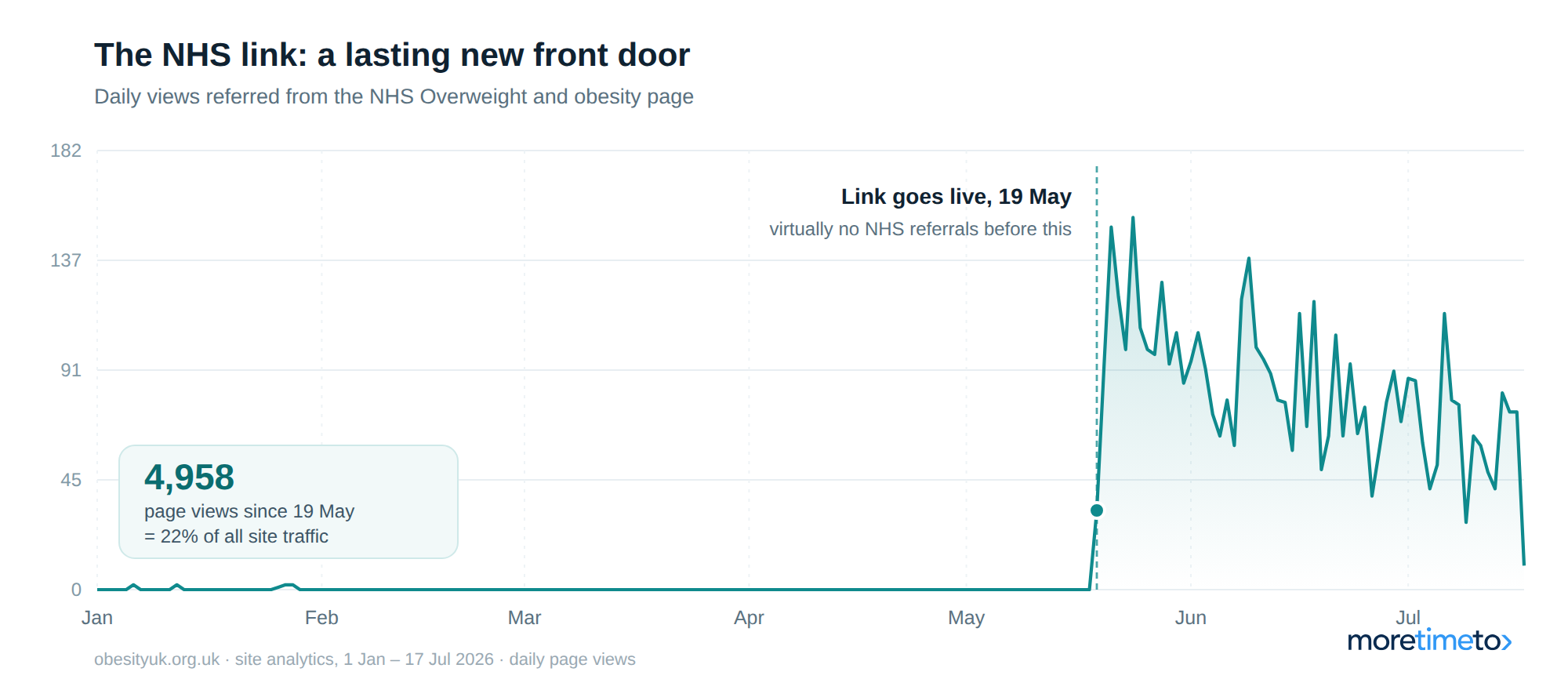
In the two months since, that single link has brought almost 5,000 visits to our website. To put that in proportion: more than one in five visits to obesityuk.org.uk now begins on an NHS page.
Before 19 May, that page sent us virtually nothing. The change in our analytics is about as clear as these things get — a flat line for 138 days, and then a step change that hasn’t let up since.
It hasn’t faded
New links often produce a burst of traffic that quietly disappears within a fortnight. This one has done the opposite:
- May (from the 19th): 1,376 visits
- June: 2,489 visits
- July (first 17 days): 1,084 visits
June was nearly double May’s partial month, and July is tracking steadily. This isn’t a launch spike — it’s become one of the main front doors to everything we do.
Where people go when they arrive
This is the part we find most meaningful. People arriving from the NHS page don’t just glance at our homepage and leave. Here’s where they actually go:
| Page | Visits |
| Home | 2,124 |
| Support Groups | 819 |
| What Is Obesity | 447 |
| About Us | 380 |
| Our Work | 347 |
| Abbie’s Story | 109 |
Support Groups is the second most visited destination.
Think about what that means. Someone reads an NHS page about a health condition, follows a link to a charity, and the thing they look for is other people. Not another leaflet. Not another set of instructions about diet. People who understand what this is like.
It confirms something we’ve long believed: alongside good information, what people need most is to feel less alone with it. The fact that hundreds of people have made that journey in two months tells us the connection between clinical information and peer support is one worth strengthening.
We also see a meaningful number reading Abbie’s Story. When you’re newly diagnosed and looking for something to hold onto, another person’s honest account of their experience can matter more than any amount of clinical explanation.
What this doesn’t mean
We want to be straightforward about this, because it matters.
The NHS linking to us is not an endorsement, an accreditation, or a formal partnership. It means their content team considered us a useful source of support and information for people looking for it. That’s a meaningful vote of confidence in our work — and we’re grateful for it — but we don’t want to overstate what it is.
What it does mean is that people who need support are finding a clearer path to it. Someone who might otherwise have closed the tab and carried on alone now has somewhere obvious to go.
If you’ve arrived here from the NHS — welcome
If you found us through that link, here’s what we’d suggest.
→ Our support groups are free, online and in person, and run by people who understand obesity from the inside. You don’t have to talk. Plenty of people listen for a few sessions first.
→ What Is Obesity explains the condition clearly and without judgement — what it is, what causes it, and what genuinely helps.
→ Our stories are accounts from people living with obesity, in their own words.
Whatever brought you here, you’re welcome. There’s no obligation, no cost, and no lecture waiting for you.